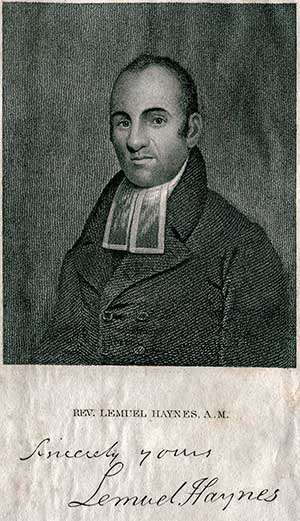
Lemuel Haynes

Born in West Hartford, Connecticut July 18, 1753. Lemuel Haynes was the son of a black man and a Scotch servant girl, Alice Fitch, who was employed by John Haynes of West Hartford. In Lieu of an orphanage, he was bound out when 5 weeks of age to a Deacon Rose of Granville, MA. Enlisted as a Minute Man in the Colonial Army, 1775; Volunteer in expedition to Ticonderoga, 1776. Supplied, Congregational church, Granville, NY 1780. Ordained, 1785. Pastor, Torrington, Connecticut 1785-1787; Rutland, Vt. 1787-1818. Removed to Manchester, VT, 1818. Pastor, Granville, NY 1822-1833. Author: "Divine Decrees, an Encouragement to the Use of Means" and "Universal Salvation," his response to Hosea Ballou a popular preacher of the day. Lemuel Haynes was married to Elizabeth Babbit, 22 September 1783 at Hartland, Connecticut by Rev. Samuel Woodbridge. She was born 29 February 1763 at Dighton, Massachusetts and died 8 February 1836.

It is said that all his children were born in Vermont:

1. Elizabeth Haynes born 1785, married Benjamin Capron, Jr. 24 Feb 1809

2. Eunice Haynes born 3 Mar 1789 died 1831 at Granville, NY, unmarried.

3. Electra Haynes born 26 July 1791

4. Lemuel Haynes, Jr. born 11 July 1794

5. Sally Haynes born 6 May 1796

6. Olive Haynes born 9 August 1798 died 19 Sept 1823

7. Pamela Haynes born 14 October 1800

8. Samuel Woodbridge Haynes born 11 Jan 1803, a physician in NY

9. William Babbitt Haynes (twin) born 11 Jan 1803, a lawyer in MA.

10. Lois Haynes (no further information)

He died in Granville, NY September 18, 1833.

To the next generation
Home
More excerpts from the Cooley biography that I think help fill out Lemuel's character

Excerpt from,

"The Life and Character of the Reverend Lemuel Haynes" 1837

by Rev Timothy M. Cooley

..."Mothers love, and love for ever." The affection of a mother to her new-born infant is one of the most powerful and active of the natural instincts. But mothers "may forget." This unhappy child was abandoned by his parents in early infancy, and was never, to the end of life, favoured with a single expression of a mother's kindness, he was thus an orphan, not by the bereaving hand of God, but by the cold neglect of those who ought to have been his most affectionate guardians. The tincture of his skin he knew to be an obstacle to his being identified in interest and in life with those among whom he dwelt. His susceptible mind soon began to feel its forlorn condition. In the bitterness of his grief, he must often have uttered his complaint in language like the following: " Let the day perish wherein I was born; let darkness and the shadow of death stain it." His mother refused to visit him or to see him. Tradition says, that when a lad, he providentially met his mother in an adjoining town, at the house of a relative; and then he fondly expected that he should at least receive some kind attentions from her. But he was sadly disappointed. She was determined to elude the interview. At length he caught a glimpse of her as she was attempting to escape from him. Vexed and mortified at such an instance of unnatural contempt from his mother, he accosted her in the language of severe but merited rebuke.

* "Mater' tu non timebas----semel; si timuras-me a gravissimo dolore, atque te ipsam, a maximo pudore, servvavisses."

Note:

To be fair, there might be forces at work on Lemuel's mother, Alice Fitch, that are not being mentioned in this history. Lemuel was born into a prominent West Hartford family's household. It is telling that he was given the surname of the master of the house rather than her own or that of his father. This is the way a slave would be named. She was probably an indentured servant. As cold as she is made to sound here she may have been given little choice in the matter considering the upright nature of the families involved.

The following is a description of the family that raised Lemuel and their relationship to TM Cooley the author of the Haynes biography:

TIBBALS FAMILY TREE IN AMERICA BRANCH FROM THOMAS TIBBALS I TO THE GRANDCHIDREN OF JACK & MARJORIE (CORRIGAN) TIBBALS (Edited in 1985 by James R. Tibbals from letters written by Ethel Tibbals Osborne in 1966.)

In March 28,1759 John married this Olive Rose (first Olive) and she bore him two sons; John born in 1760 and David in 1761. She died 1762. The above David Rose Tibbals, whom we know to be our direct ancestor and Elizabeth, his wife took a "bound-boy" Lemuel Haynes, whose father was a Negro and his mother a white girl. His parents abandoned him and as there were no children's homes in those times, the county "bound him out"as a sort of indentured servant. He was only 5 weeks old and told in later life how his mistress treated him as "one of her own". He was born in Hartford on July 18,1753 and lived with the Rose (Tibbals) family until the Revolutionary War days when he joined the army and fought along with John Tibbals Sr., John Jr. and David Tibbals at Ticonderoga. This Lemuel Haynes was the first colored Preacher ordained in the Congregational Church. He married a white woman, Elizabeth Babbit of Dianton (?) (actually Dighton a suberb of New Bedford) Massachusetts, a young and well educated white woman of excellent family. He died in Granville, New York, September 28,1834 while preaching there. Life story in small volume called "Memoirs of Lemuel Haynes", by Timothy M. Cooley - (an accurate account).

On the author of the Haynes biography

In 1792 John Jr. married Dorothy Cooley, daughter of William and Sarah Cooley and a sister of Timothy Mather Cooley, long time pastor of church in Granville. The second son was Wm John, my great-grandfather; the daughter was Olive Tibbals who married Stephens Holmes. (The elder son was Timothy Cooley Tibbals referred to in Rev. T. M. Cooley's address in 1845. He died before 1831.) In 1845 Granville celebrated the 50th year of Timothy M. Cooley's pastorate and in his speech he mentions the death of the 1St Timothy Cooley Tibbals and we know by the will of Dorothy Cooley Tibbals that he died prior to 1831, the date of that will. They-- the Oranvillites observe this anniversary every 50 years (The next celebration is in 1995). The Church was known as the First Church of Christ Congregational.

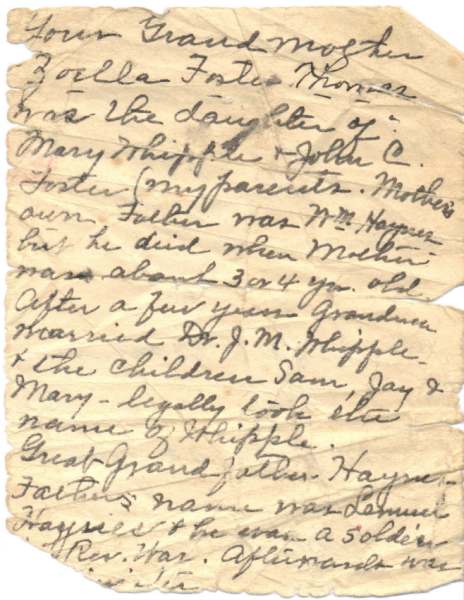
Eloise Hamil wrote to Bertha Foster in the early 1960's asking if any of our family had been in the Revolutionary War. This is Bertha's response.

The other mention of Lemuel Haynes that I found was from David Barth. He has not been able to find a record of William Haynes and Mary Cases wedding or their children, Sam, Mary Elizabeth and William Jay. This would be sure proof. There are, however, other Whipple family anecdotes regarding the connection.


Most of this information on Lemuel has been found on the internet. I have ignored what I thought to be wrong. A main source has been:

Link to Google digitized copy:
Rev Timothy M. Cooley, "The Life and Character of the Reverend Lemuel Haynes" 1837

Albion B. Wilson, "History of Granville, Massachusetts" (Hartford, Connecticut Printers, 1954).
(I have been unable to find this book)

There is a PBS webpage on Lemuel that is up as of October 2001. http://www.pbs.org/wgbh/aia/part2/2p29.html

Lemuel has been the focus of historical study. The most useful to me are the ones that give Lemuel a context in his own time. One text has an impressive explanation of the religious currents of that time. It can be found at:

http://college.hmco.com/english/lauter/heath/4e/students/author_pages/eighteenth/haynes_le.html

This link has .that is taken from:
The Heath Anthology of American Literature, Fifth Edition
Paul Lauter, General Editor
and is written by:
Phillip M. Richards, Colgate University, Lemuel Haynes (1753-1833)

Select link, above, to go to the text page.